Views
Views are short interpretive historical presentations from materials in the Railroads collection. Each View is aimed a research question or problem and assembles information from multiple sources: documents, lists, records, orginal maps, and other historical sources. Rather than using traditional footnotes or citations, these Views contain direct links and references to relevant sources used in their assembly. Views are "assemblages" of data and interpretation and should be considered multimedia experiments in the presentation of digital history.

William Jennings Bryan's Railroad Campaign in 1896
In the 1896 Presidential Campaign Democratic candidate William Jennings Bryan took four major railroad trips, sometimes giving over a dozen speeches at stops along his route. We have compiled all of Bryan's speeches from newspaper sources and his personal papers. Here, using Token X you can analyze all of speeches with word searches, word clouds, and other analytical visualizations. By Nathan G. Sanderson and William G. Thomas.
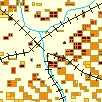
Southern Railroads and Freight Traffic: Cotton Only or More?
Southern antebellum railroads have been characterized as limited in their impact. By the 1850s, however, many southern roads were doing brisk business both up and down their lines. The Virginia and Tennessee Railroad, for example, carried a range of products in its Eastward and Westward Freight Traffic, 1855-56, reported in its annual report.

Railroad Network Expansion in the United States
Railroads expanded across the United States in bursts of construction and consolidation. A "network" often did not exist, as lines failed to join one another at stations and competitive privileges of rival companies thwarted unification at key points. Yet, the railroad's spatial development in the U.S. placed localities on an ever-shifting map. Over time a locality's position might change in relationship to others, and over time network effects characterized the process of railroad growth and change. An event at one point affected other places.
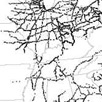
Technology, Modernity, and the U.S. South before the Civil War
Railroads and telegraphs changed the ways white southerners thought about their region. These technologies altered the landscape of the South, linked cities and sub-regions into a rapidly expanding network, and brought the majority of white southerners into close access of the railroads. The modernizing influences of these developments came hand-in-hand with the expansion of slavery in the 1850s. White southerners increasingly saw their region as advanced, modern, and technologically sophisticated. Their adaptation of slavery to railroad construction and operation only encouraged a sense of confidence about the progress.

Passenger Mobility in the 1850s
The first experience of the railroad for many Americans was a revelation. Passenger traffic developed quickly as the railroads extended their lines from city to city. Small towns became linked with the larger urban centers and Americans' increased mobility changed conceptions of time, space, distance, and identity.

The Great Railway Strike of 1877 and Newspaper Coverage
The Great Strike of 1877 raised questions about the nature of modern American society and its increasingly interdependent and networked economy. Americans wondered if the railroads that had been such a part of the modern nation's sectional crisis and figured so prominently in its triumph were now also its greatest weakness, a network that no longer unified but exposed the nation. Newspaper editors shaped coverage of the events with explosive headlines, focused stories, and politically charged editorials about the strike. Their language and detailed descriptions captured the intensity and personal struggle among the workers and middle-class Americans viewing these events with alarm.
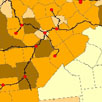
The Growth of Slavery and Southern Railroad Development
Southern railroads extended in the 1850s to places where slavery was not yet firmly established by white planters. The upcountry South, the Appalachian mountains, and the western borders of the South were all areas of significant railroad development. Wherever railroads went, slavery and some form of plantation agriculture followed. White southerners saw little inconsistency between slavery and industrial development, especially railroads.
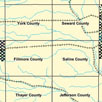
Land Sales in Nebraska: Comparing Two Nebraska Counties on the Burlington Railroad
When construction of its main trunk began in 1869, The Burlington & Missouri River Railroad in Nebraska received a significant land grant from the federal government. The railroad joined the federal government, local governments at all levels, boosters, and other corporations in efforts to “colonize” the region. The railroad not only shaped the western landscape by privileging access to its network, junctions, and depots, but also shaped the western experience by enabling widespread mobility, immigration, and ethnic diversity. The railroad's modernizing influence took many forms but the marketing, selling, and opening of its lands had especially significant long-term effects on the Great Plains. By Kurt Kinbacher, William G. Thomas, Dan Becker, and Zach Bajabar.
Northern Expansion in the 1850s
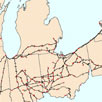
The Illinois Central Railroad received the first federal land grant in September 1850. The area comprised some 2,595,000 acres in Illinois. The railroad opened the lands for sale in 1852 and began a sophisticated land marketing and promotion operation to attract settlers onto the prairies. The Land Department advertised in Europe, printed detailed brochures explaining how lands could be bought with ten-year mortgages, and provided excursion rates for land settlers to travel west and see the lands for themselves. The rapidity of the sales fueled extraordinary growth of towns along the line. Northern railroad expansion in the Midwest matched Southern railroad growth in the 1850s. Both sections understood their development in sectionalized terms.
William Jennings Bryan's 1894 U. S. Senate Campaign and American Politics
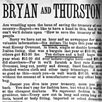
William Jennings Bryan ran for the U.S. Senate in Nebraska in 1894 just two years before his run for the presidency at the head of the Democratic and Populist ticket. 1894 was a year of turmoil in American life, as strikes, violence, and economic depression rocked the nation. Byran's campaign was an important precursor to his national candidacy in 1896.
Women’s Experience on the Great Plains in the 1850s
Sarah Sim and her husband Francis Sim migrated to Otoe County, Nebraska Territory, in 1856 to start a farm. Their trials and travails included the death of three of their children, the near suicide of Sarah, and the difficulties of moving to and farming in the Great Plains in the 1850s. This podcast with Leslie Working and William G. Thomas explores the significance of these letters and of the Sims’ experience in the years before the Civil War.
Death and Dying in 19th Century America
This podcast with William G. Thomas and Leslie Working considers the experience of death and dying for 19th century Americans and the significance of changing ideas about death in American society. Sarah Sim and her husband Francis Sim migrated to Otoe County, Nebraska Territory, in 1856 to start a farm. Their trials included the death of three of their children, the near suicide of Sarah, the difficulties of moving to and farming in the Great Plains in the 1850s, and the death of Sarah from breast cancer in 1880.
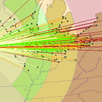
Travel Time--How Railroads Shaped Time and Space
Henry Adams, in The Education of Henry Adams, remarked, "The generation between 1865 and 1895 was already mortgaged to the railways, and no one knew it better than the generation itself." The railroads were a centripetal and centrifugal force, a kind of powerful vortex, in American society. Their reach into the lives of everyday Americans, was Henry Adams' chief concern. He could see that railroads were "but one active interest, to which all others were subservient, and which absorbed the energies of some sixty million people to the exclusion of every other force, real or imaginary." Railroad corporations employed thousands and their services spanned the continent, reshaping the economies and social relations in whole regions. For everyday Americans the railroad cut travel time and changed the spatial relationships in their lives.
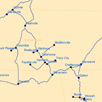
The Atlanta Campaign of 1864
The campaign for Atlanta was fought on the Western and Atlantic railroad line between Chattanooga, Tennessee, and Atlanta over the summer of 1864. When Atlanta fell to the Union Army commanded by William T. Sherman, the course of the Civil War shifted. General Ulysses S. Grant ordered Sherman to "to move against Johnston's army, to break it up, and to get into the interior of the enemy's country as far as you can, inflicting all the damage you can against their war resources. . . ." Sherman's railroad campaign set out to master the South's landscape and control the region's network of communication and transportation. To accomplish this objective Sherman and his commanders needed geographic vision. By Trevor Munoz and William G. Thomas.
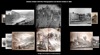
The Railroad in Art
This view uses Imageflow software to present galleries of images of the railroad. We include the full run of images in Porte Crayon's "Artists' Excursion on the Baltimore and Ohio Rail Road" in Harper's Monthly, June 1859. And other collections of images for comparison and analysis. By Rebecca Wingo, Leslie Working, and William G. Thomas.
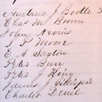
Railroad Workers and Railroad Work
In the 1850s railroads hired thousands of working people to build and operate their growing lines. In 1857 the Baltimore and Ohio Railroad recorded every employee on the line. Over 6,000 individuals worked for the B & O in a variety of roles. At least one woman was employed by the company, Sarah Mally, as well as many free blacks and Irish immigrants. Our database will track these individuals over time and in coming months we will add more data from different railroads on slave laborers, Irish, and other workers. By Richard G. Healey, Katie Dooley, and William G. Thomas
Black Labor, Contrabands and the U.S. Military Railroads in the Civil War
The Civil War created new zones of emancipation along the railroads. Data and events compiled from The War of the Rebellion: A Compilation of the Official Records of the Union and Confederate Armies, Cornell University Library, Making of Modern America. Compiled by A. J. Delong, Leslie Working, and William G. Thomas, 2009.
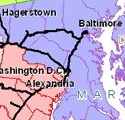
Network Connectivity--A Close Analysis of the Baltimore and Ohio Railroad's Expansion
The Baltimore and Ohio Railroad was the first railroad to break through the Allegheny Mountains and reach the Ohio River. The route to the Ohio was completed in1857, but throughout the nineteenth century the company acquired other railroads, expanded its operations, and reconstituted its system. This view explores the dynamic expansion and contraction inherent in these systems. Rather than a uniform process of growth, railroads underwent spatially uneven and disjointed development over long periods of time. By Richard G. Healey and William G. Thomas.
Violence and Expansion on the Great Plains
As railroads expanded across the Great Plains West, white settlement also spread through the region, encroaching upon Native American lands. Conflict among settlers, and between whites and Native peoples followed. Andrew Graybill and William G. Thomas compare violence and expansion on the Great Plains with the U. S. South, focusing especially on the Marias Massacre in Montana.
Railroads and Women's History on the Great Plains
NET Radio Interview with William G. Thomas and Leslie Working explores the project goals and the ways railroads have been presented in history.

Appendix Tables for "The Iron Way"
Additional charts and tables for "The Iron Way: Railroads, the Civil War, and the Making of Modern America."
Strikes, Blacklists, and Dismissals--Railroad Workers' Spatial History on the Great Plains
Beginning in the 1880s railroad companies began compiling blacklists of employees dismissed for cause. During the turbulent stirkes in 1886 and 1888, western railroads began sharing these lists so that an employee dismissed on one road might not be hired on another. This map represents over 1,000 Union Pacific dismissals, by their location and cause. By Leslie Working, Richard G. Healey, and William G. Thomas.

Map Inaccuracies in Railroad Sources
Developing a Historical Geographic Information System (H-GIS) for railroads in the United States reveals numerous inaccuracies in historical railroad atlases and maps. In this case study we examine some of the problems we faced in developing and integrating rail GIS from the University of Nebraska and the University of Portsmouth.