Views
Views are short interpretive historical presentations from materials in the Railroads collection. Each View is aimed a research question or problem and assembles information from multiple sources: documents, lists, records, orginal maps, and other historical sources. Rather than using traditional footnotes or citations, these Views contain direct links and references to relevant sources used in their assembly. Views are "assemblages" of data and interpretation and should be considered multimedia experiments in the presentation of digital history.
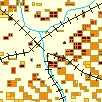
Southern Railroads and Freight Traffic: Cotton Only or More?
Southern antebellum railroads have been characterized as limited in their impact. By the 1850s, however, many southern roads were doing brisk business both up and down their lines. The Virginia and Tennessee Railroad, for example, carried a range of products in its Eastward and Westward Freight Traffic, 1855-56, reported in its annual report.
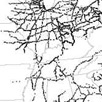
Technology, Modernity, and the U.S. South before the Civil War
Railroads and telegraphs changed the ways white southerners thought about their region. These technologies altered the landscape of the South, linked cities and sub-regions into a rapidly expanding network, and brought the majority of white southerners into close access of the railroads. The modernizing influences of these developments came hand-in-hand with the expansion of slavery in the 1850s. White southerners increasingly saw their region as advanced, modern, and technologically sophisticated. Their adaptation of slavery to railroad construction and operation only encouraged a sense of confidence about the progress.
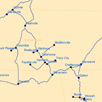
The Atlanta Campaign of 1864
The campaign for Atlanta was fought on the Western and Atlantic railroad line between Chattanooga, Tennessee, and Atlanta over the summer of 1864. When Atlanta fell to the Union Army commanded by William T. Sherman, the course of the Civil War shifted. General Ulysses S. Grant ordered Sherman to "to move against Johnston's army, to break it up, and to get into the interior of the enemy's country as far as you can, inflicting all the damage you can against their war resources. . . ." Sherman's railroad campaign set out to master the South's landscape and control the region's network of communication and transportation. To accomplish this objective Sherman and his commanders needed geographic vision. By Trevor Munoz and William G. Thomas.
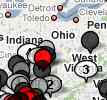
Black Labor, Contrabands and the U.S. Military Railroads in the Civil War
The Civil War created new zones of emancipation along the railroads. Data and events compiled from The War of the Rebellion: A Compilation of the Official Records of the Union and Confederate Armies, Cornell University Library, Making of Modern America. Compiled by A. J. Delong, Leslie Working, and William G. Thomas, 2009.