Views
Views are short interpretive historical presentations from materials in the Railroads collection. Each View is aimed a research question or problem and assembles information from multiple sources: documents, lists, records, orginal maps, and other historical sources. Rather than using traditional footnotes or citations, these Views contain direct links and references to relevant sources used in their assembly. Views are "assemblages" of data and interpretation and should be considered multimedia experiments in the presentation of digital history.

Railroad Network Expansion in the United States
Railroads expanded across the United States in bursts of construction and consolidation. A "network" often did not exist, as lines failed to join one another at stations and competitive privileges of rival companies thwarted unification at key points. Yet, the railroad's spatial development in the U.S. placed localities on an ever-shifting map. Over time a locality's position might change in relationship to others, and over time network effects characterized the process of railroad growth and change. An event at one point affected other places.
Technology, Modernity, and the U.S. South before the Civil War
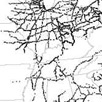
Railroads and telegraphs changed the ways white southerners thought about their region. These technologies altered the landscape of the South, linked cities and sub-regions into a rapidly expanding network, and brought the majority of white southerners into close access of the railroads. The modernizing influences of these developments came hand-in-hand with the expansion of slavery in the 1850s. White southerners increasingly saw their region as advanced, modern, and technologically sophisticated. Their adaptation of slavery to railroad construction and operation only encouraged a sense of confidence about the progress.
Northern Expansion in the 1850s
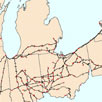
The Illinois Central Railroad received the first federal land grant in September 1850. The area comprised some 2,595,000 acres in Illinois. The railroad opened the lands for sale in 1852 and began a sophisticated land marketing and promotion operation to attract settlers onto the prairies. The Land Department advertised in Europe, printed detailed brochures explaining how lands could be bought with ten-year mortgages, and provided excursion rates for land settlers to travel west and see the lands for themselves. The rapidity of the sales fueled extraordinary growth of towns along the line. Northern railroad expansion in the Midwest matched Southern railroad growth in the 1850s. Both sections understood their development in sectionalized terms.
Strikes, Blacklists, and Dismissals--Railroad Workers' Spatial History on the Great Plains
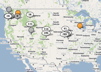
Beginning in the 1880s railroad companies began compiling blacklists of employees dismissed for cause. During the turbulent stirkes in 1886 and 1888, western railroads began sharing these lists so that an employee dismissed on one road might not be hired on another. This map represents over 1,000 Union Pacific dismissals, by their location and cause. By Leslie Working, Richard G. Healey, and William G. Thomas.